

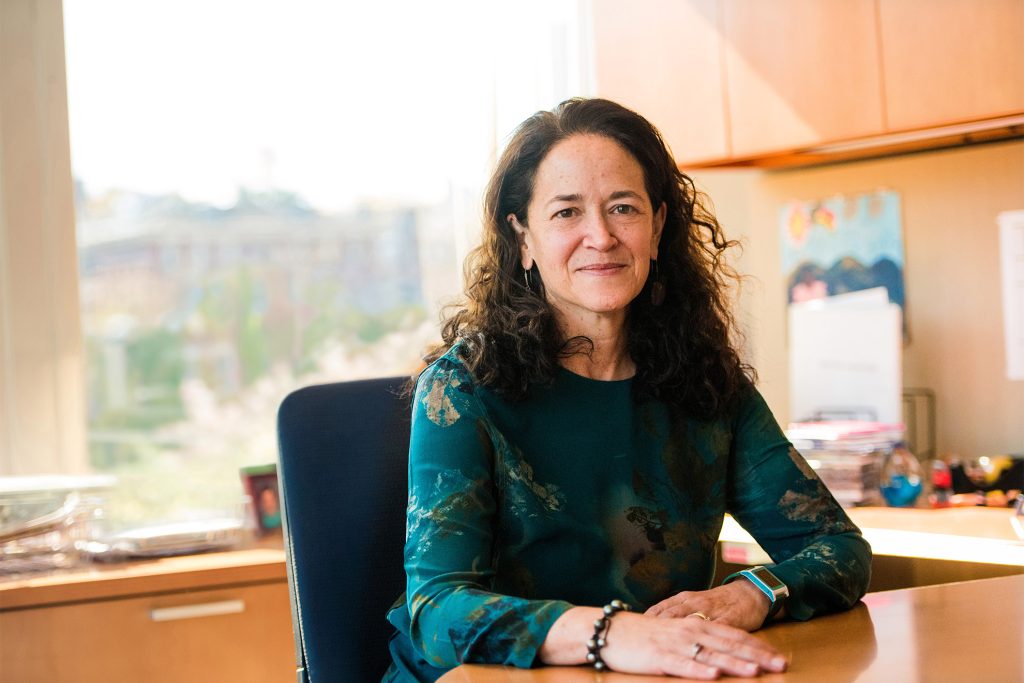

Merit Cudkowicz.
Health
Glint of light in therapy for deadly ALS after decades of struggle
New drug shows researchers ‘this illness can be stopped’
Merit Cudkowicz has been working on ALS for three decades. She knew who she wanted to tell as soon as she was able to discuss the breakthrough findings publicly.
“The first person I called was the husband of my very first [ALS] patient, when I was a fellow,” she said.
His wife had been diagnosed at 44 with the fast-moving A4V variant of the deadly disease. The intervening decades were a period marked by “a lot of trials, a lot of progress, but nothing really earth-shattering, right?” Cudkowicz said.
Until now.
A paper published this winter in JAMA Neurology found that a new drug, called tofersen, can radically slow and even reverse the course of the disease in a small subset of patients with a rare genetic variant.
It is a small but unprecedented glint of light in the long, dark struggle with what used to be called Lou Gehrig’s disease, both for the patients who had been staring down certain paralysis and death and for the researchers who work on the disease.
Cudkowicz, the Harvard Medical School Julieanne Dorn Professor of Neurology at Massachusetts General Hospital and a co-author of the paper, said the data reveal was “the best day” in her years of confronting ALS.
“It tells the whole field that this illness can be stopped. We thought that was true, hypothetically, but we had never seen it,” she said.
December’s findings came only after years of fitful progress; the paper lists almost two dozen researchers in eight countries. Eleven are based in Boston or Cambridge, including at biotech pioneer Biogen, which is marketing the drug as Qalsody.
Cudkowicz, who directs the Sean M. Healey and AMG Center for ALS, was involved almost from the start.
“I think it was in 2010 that Tim called me,” she said, referring to Timothy Miller, the lead author and an ALS researcher at Washington University in St. Louis. “They had this great therapeutic idea, but they had never developed a clinical trial before and asked if we could help.”
Amyotrophic lateral sclerosis is uncommon, but its progress is terrifying: something like an irreversible rolling blackout of the motor neurons. What first appears as a slight weakness in the leg or twinge in the throat proceeds to eat away at the muscles, robbing patients of everyday mobility, speech, swallowing and, eventually, breath.
The disease is fickle and incompletely understood. It can progress over decades or kill within a year. Some types are inherited, or “familial,” others “sporadic” — apparently caused by an unseen succession of genetic and environmental causes.
And more than 150 years after it was first diagnosed, medical science has learned to manage ALS, but not cure it.
Cudkowicz was well-positioned to help usher this treatment into the world. In 1995, as a Harvard Medical School resident in neurology, Cudkowicz co-founded the Northeast ALS Consortium, or NEALS. Over the years, it has become a global hub for drug trials that bear on the disease (and changed its name to reflect that broader reach).
Drug trials — often drawn out — are especially difficult with cutting-edge therapies like the one Miller had proposed.
Tofersen is an antisense oligonucleotide, something like a “correction tape” that masks a dangerous piece of genetic code. In this case, it binds to the site of what is called the SOD1 gene.
As first discovered in the lab of Robert Brown at Harvard Medical School in 1993, that gene, when mutated, can produce toxic, misfolded proteins that clump in the spinal cord and brain, causing neuron death.
Cudkowicz said such a treatment had never been approved for use in the human brain, and the path to approval wasn’t straightforward.
A first study in 2010, she recalled, “had some toxicity in the animal studies” and never made it to a human trial.
Miller kept up work through years of biochemical retooling, resulting in the version of the drug that the FDA approved in 2023.
“We’ve been collaborators from the beginning, but it’s his brainchild,” Cudkowicz noted.
By the numbers, the benefits of this drug will be extremely narrow. The study was aimed only at patients with the rare SOD1 genetic subtype of ALS, and only a fraction of those participants showed the most dramatic improvements.
As it first gave approval, the FDA estimated that fewer than 700 Americans might be eligible.
And the therapy is still a major undertaking. The sticker price is between $150 and $180,000 a year — actually affordable, Cudkowicz said, compared to some other emergent gene therapies, but sometimes prohibitively expensive without insurance.
“In Massachusetts, we’ve been able to get coverage for patients. Here we’ve seen someone on a Tuesday, had approval by Friday, and started treating them Monday,” Cudkowicz said. “But it’s not like that state-to-state, and some European countries still won’t pay for it. It’s awful.”
And for now, patients in tofersen therapy must undergo monthly infusions directly into the spinal canal, bypassing the blood-brain barrier that would thwart oral or intravenous applications.
Despite all that, Healey Center staff have come to call their tofersen program “our happy clinic,” Cudkowicz said. “In maybe a quarter of participants, the illness stops — they get better. … We’ve started sending people back to rehab.”
Beyond those personal miracles, Cudkowicz sees other upsides to tofersen.
First, the researchers won their expedited FDA approval based on an emerging index of neurological damage called the neurofilament light chain, which can be detected in a patient’s blood. (Tofersen can lower its levels by around 50 percent, and that lowering corresponded to clinical success.)
“That kind of surrogate biomarker can really accelerate a field,” Cudkowicz said. “All of a sudden, you have something you can measure in a short time and that’s predictive — it cuts the cost of drug development.”
That will bring in new firms, she added, some of which are already pursuing less-invasive ways to administer drugs like tofersen.
And since the misfolded proteins present in the SOD1 population can sometimes be found in people without these genetic mutations, others have launched a small trial to see whether tofersen can help in those far more common cases of “sporadic” ALS.
Tofersen appears to work best when administered early, and there is another benefit.
Cudkowicz’s team has already partnered with the University of California’s San Francisco campus to analyze patients’ skin samples and identify potential candidates for the earliest possible intervention — and without the spinal biopsy that was once required, acting more quickly and more broadly.
But in the struggle against such a devastating illness, the human impact of a breakthrough can’t be overstated. Which is why Cudkowicz couldn’t wait to make that call to her former patient’s family.
She said, “I just wanted him to know that it finally happened” — the closest thing yet to a cure.
